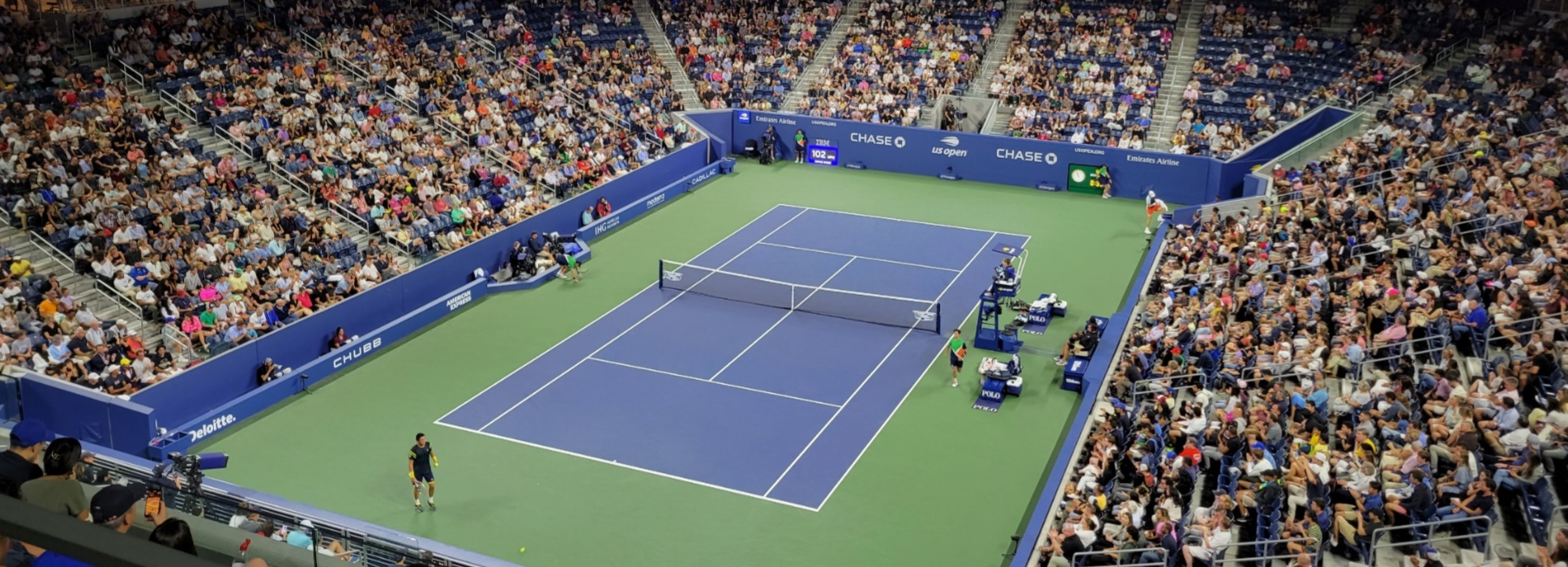
Why Tennis Pros Stand So Far Behind the Baseline
Ever wonder why some tennis pros stand way back while others hug the baseline? What is the advantage, and is it something you should be adding to your own game?
Let’s talk tennis.

To understand this properly, start at the net and work backward. If you assume solid fundamentals, the easiest place to win a point is at the net. The volley requires minimal swing, gives you clear angles, and takes time away from your opponent. It is the tennis version of a layup.
From just inside the court, you still have strong advantages. You can open the court with angles, attack short balls, and continue applying pressure. The closer you are, the more geometry works in your favor and the less time your opponent has to react.
Now move back to the baseline. You lose some angle, but at the professional level, players can still create width with spin and timing. Taking the ball early can still pressure opponents, and this is where many aggressive baseliners prefer to operate.
Now go all the way back.
Angles become harder to create. You give your opponent more time. You open yourself up to drop shots and short angles. You have more court to cover on every ball.
So why do some of the best players in the world stand that far back?
The Trade-Off: Time vs Position
The answer is simple. Time.
Modern tennis is built on power and spin. Many players take full, aggressive swings that require more time to execute. By standing farther back, they give themselves that time while still keeping the ball in play with heavy topspin.
Standing deeper also effectively lengthens the court. When you hit with high net clearance and spin, the extra distance gives the ball more space to drop back inside the baseline. That allows players to swing freely without fear of missing long.
There is also a timing advantage. From deeper positions, players often take the ball on the fall or just after the apex. The incoming ball has slowed down slightly, making it easier to control and redirect. That is a big reason why players like Daniil Medvedev have been so effective playing deep.
On return of serve, the benefit is even clearer. Standing back gives players more time to react to big serves and take a full swing, especially on second serves. Many will move forward again once the rally begins.
Of course, this positioning comes with real trade-offs. Players who stand far back should be vulnerable to drop shots, short angles, and net play. And increasingly, opponents are exploiting that.
Carlos Alcaraz has changed the dynamic with his frequent and effective use of the drop shot. Novak Djokovic has also shown how to counter deep positioning by mixing in serve and volley and taking time away.
Even at the highest level, positioning is a constant chess match.

What Should You Do?
This is where recreational players need to be careful.
For most players, standing far behind the baseline creates more problems than it solves. You give up control of the court, allow your opponent to dictate, and open yourself up to being moved side to side.
But there are situations where moving back can help.
If you are struggling with a big server, taking a few steps back can give you the time you need to make clean contact. If you are uncomfortable taking the ball on the rise, backing up can allow for a more relaxed, complete swing.
The key is understanding why you are doing it.
Professional players can make this positioning work because they have elite movement, conditioning, and the ability to generate heavy spin. They can recover from defensive positions and turn them into neutral or even offensive rallies.
Most recreational players cannot.
If you move back, your opponent will quickly test you with short balls, drop shots, and angles. If you do not have the speed and control to handle those, you will be on the defensive from the start.
First Ball Forehand Match Point
Standing far behind the baseline is not a flaw. It is a strategic choice built around time, spin, and physical ability.
Use it when it helps you. But remember, in most cases, controlling the court closer to the baseline is still the winning position.
Source: Coaching principles adapted from Stop Losing! Play Winning Tennis Now by Joe Arena.