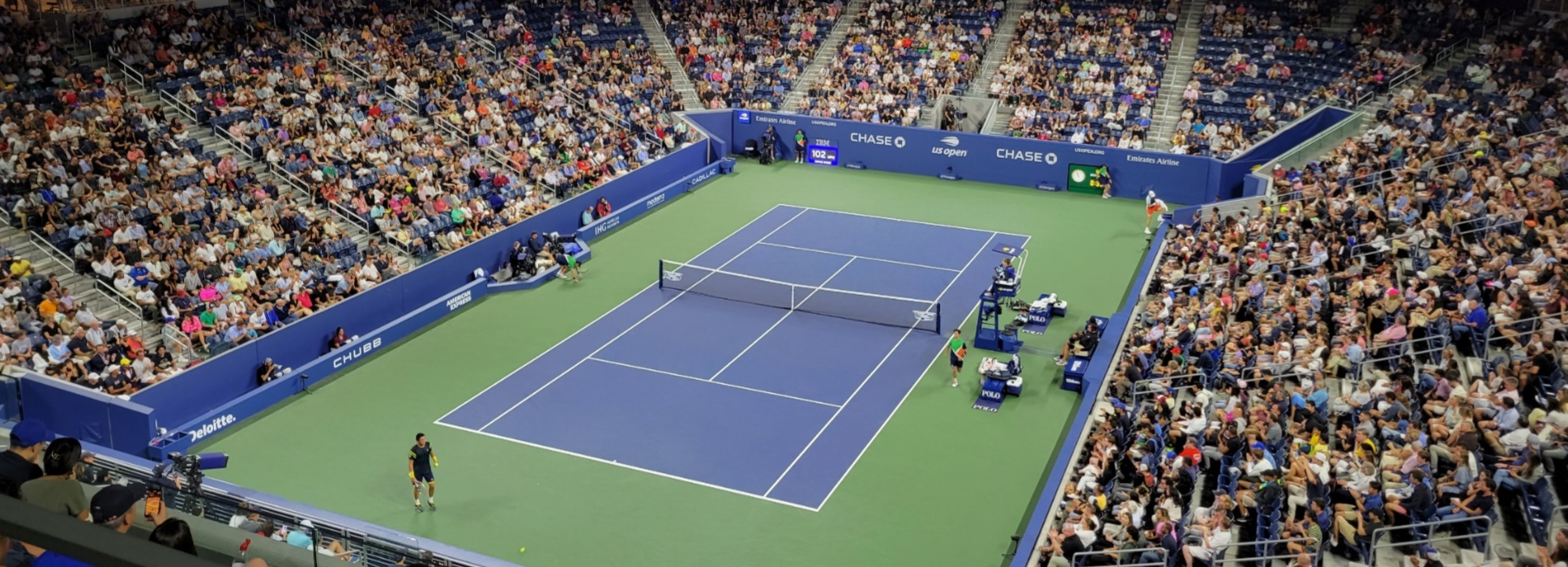
Alex Michelsen vs. Frances Tiafoe: One Game From Everything
There are things you can practice every day for years and still not completely understand until you experience them.
Serving at 5-4 in the third set of a US Open quarterfinal with a two-set lead is probably one of them.
Alex Michelsen was one game away from his first major semifinal. For much of the match, he had been the better player against Frances Tiafoe.
Then the moment arrived.
Let’s talk tennis.

_06.jpg)
Michelsen wasn’t some happy young player thrilled to have reached the quarterfinals. He was there to win. He took the first two sets from Tiafoe and put himself in position to finish the match in three.
Then, serving for it, things changed.
The arm knows it’s 5-4.
The mind knows what’s waiting on the other side of four more points.
Suddenly the court can feel a little smaller and the net a little higher.
Tiafoe broke. Then something else happened.
The veteran came alive.
Tiafoe grabbed the third set 7-5, took the fourth 6-3, and Arthur Ashe Stadium had an entirely different tennis match.
It would have been easy for Michelsen to disappear.
He didn’t.
You Can’t Practice Your First Time
Michelsen surged to an early lead in the fifth set.
That matters.
This wasn’t simply a young player choking away his opportunity and collapsing. He absorbed Tiafoe’s comeback, reset and put himself in position to win again.
Eventually, Tiafoe prevailed in a deciding tiebreak after nearly five hours.
This time, experience won.
Tiafoe is 28. He has lived these New York moments before. He knows the noise, the pressure and what it feels like when a major match starts slipping away.
He also understood what this opportunity meant.
American men’s tennis has changed dramatically around him. Ben Shelton, Learner Tien, Michelsen and others have joined Fritz, Paul and Tiafoe in a suddenly crowded conversation. For Tiafoe, another deep US Open run wasn’t something to assume would come again next year.
He played the closing stages with that urgency.
Michelsen was experiencing something different.
His career was opening in front of him.
That’s why I wouldn’t overcomplicate his lesson.
He didn’t discover that his game isn’t good enough. Quite the opposite. He proved over five sets that it absolutely belongs on this stage.
What he learned was how heavy closing a match like this can feel.
We love telling players to treat every point the same. That’s good advice.
But every point isn’t the same.
Serving out a Tuesday-night league match isn’t serving for your first US Open semifinal on Arthur Ashe Stadium. No amount of pretending changes that.
Experience teaches you how your body responds. How your breathing changes. Whether you rush. Whether you become cautious. Whether you start thinking about the finish line instead of the next ball.
Michelsen knows now.
The next time he reaches that moment, it won’t be his first time.
And that might make all the difference.

.jpg)
First Ball Forehand Match Point
Sometimes you have to feel the pressure before you can learn how to play through it.
Michelsen lost the match. He gained an experience no practice court could possibly reproduce.
Source: Publicly available ATP/WTA reporting and season coverage.